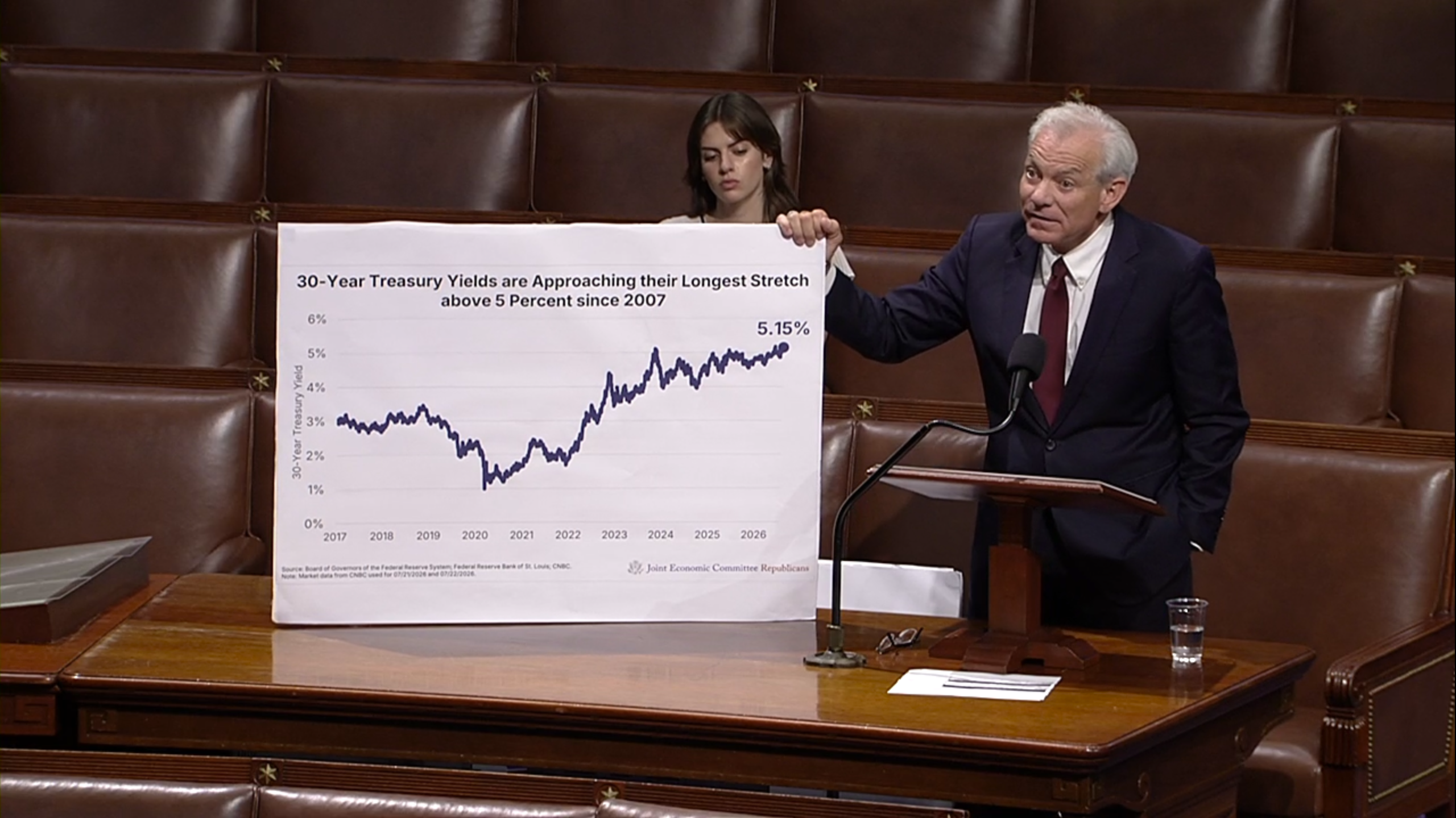
WASHINGTON, D.C. — Rep. David Schweikert (AZ-01) took to the House floor this week to walk through new borrowing data compiled by the Joint Economic Committee and warn that interest costs are on track to become the single largest expense of the federal government.
Citing the Committee’s Daily Debt tracker, which pulls figures directly from the Treasury’s management system every workday, Schweikert reported the United States has borrowed $2.948 trillion over the last 12 months, an average of $93,763 every second. Borrowing for the current fiscal year has already reached $2.022 trillion against original projections of roughly $1.7 trillion, with the year now heading toward $2.3 trillion.
“Anyone want to take a guess how many days it takes us to borrow another trillion dollars? 123 days. Every 123 days we’re ticking off another trillion dollars,” Schweikert said.
Total U.S. debt now stands at $39.66 trillion and is expected to cross $40 trillion by the end of the summer work period. Last year the federal government spent $1.43 for every dollar it collected in taxes. This fiscal year that figure is running closer to $1.47.
Schweikert laid out the hierarchy of federal spending: Social Security first, interest second, Medicare third, Medicaid and Affordable Care Act subsidies fourth and national defense fifth. Gross interest, which includes interest owed back to the Social Security and Medicare trust funds, will approach $1.28 trillion this year and is projected to surpass Social Security as the government’s largest expense by 2037. Under baseline policy, more than 30 cents of every tax dollar collected will go to interest within nine budget years.
The remarks focused on what Schweikert calls interest fragility, the outsized damage small rate increases inflict on a government carrying nearly $40 trillion in debt. With 30-year Treasury yields approaching their longest stretch above 5 percent since 2007, he noted that a sustained 60 basis point increase adds roughly $2 trillion in interest costs over ten years. Joint Economic Committee analysis also finds federal borrowing has pushed mortgage rates about one point higher than they would otherwise be, making the government a direct contributor to America’s affordability crisis.
“We’re going to bring down this republic, and it’s not going to be some mob coming over the border. It’s going to be our own fiscal insanity,” Schweikert said. He pointed to recent modeling discussions with the Penn Wharton Budget Model suggesting that under current policy the United States could hit a debt spiral within 12 to 14 years, a point at which the government can no longer sell bonds. Greece, Spain and Italy can each sell a ten year bond at a lower rate than the United States today.
Schweikert also highlighted the consequences of inaction on entitlements. The Medicare trust fund is projected to run dry in six years and two months, triggering a 12 percent cut to hospital reimbursements, while Medicare spending doubles from $1 trillion to $2 trillion over the same window. In roughly 26 months, the majority of all federal spending will go to Americans 65 and up.
During his remarks, Schweikert publicly held House leadership to a commitment made to his team to convene committee chairs and Joint Economic Committee economists on a package of legislation his office has developed over the past year to cut spending and borrowing without removing services, including reforms targeting the hundreds of billions of dollars in misaligned payments identified in MedPAC reports and an estimated $350 billion over ten years in duplicative medical scans.
“There’s ways we’re not going to pay it off, but we can stabilize it,” Schweikert said. “The bond market will live in facts, and eventually it’s going to kick us in the head unless we can do some tough things to convince it we’re creditworthy.”